Hemp Lime as a Sustainable Material for Tomorrow’s Buildings

The construction industry is responsible for about 50% of waste and around 40% of global CO₂ emissions. Hemp lime reverses this ratio: instead of causing emissions, it actively stores CO₂. Instead of producing waste, it is endlessly recyclable.

Hemp grows extremely fast, can be cultivated in many parts of the world, and has very high yields per hectare. Because it can be used for two purposes, it also brings a degree of independence.

Hemp lime combines timber construction and solid construction into a scalable hybrid building system that merges lightness with mass. This creates decisive advantages: increased fire protection, improved sound insulation, and effective thermal storage that keeps rooms cool in summer. While lightweight insulation materials only offer limited protection against heat, hemp lime creates a healthy, comfortable indoor climate — ecological, efficient, and feasible for projects of any size.

Through easy separability, healthy indoor air, and long durability, hemp lime offers real prospects for regenerative architecture.

Building with hemp and lime means:


  • Circular

  • Climate-positive

  • Healthy to live in

  • Future-proof

Hemp - the versatile raw material for a sustainable life 


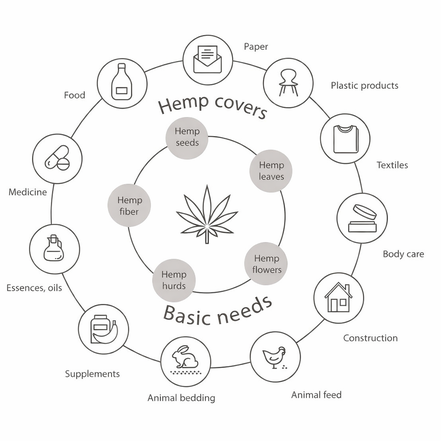
The hemp plant meets some of the most basic human needs:

It provides nutrient-rich food, robust and durable clothing, and natural fibers for textiles. At the same time, it offers sustainable building materials that enable healthy and ecological living. Hemp is therefore an exceptionally versatile raw material -ecological, resource-saving, and ideal for a conscious lifestyle that is in harmony with nature.
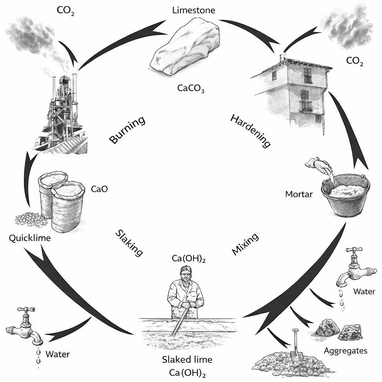

The Lime Cycle – Explained Simply


  • Starting material: Limestone (CaCO₃)

  • Heating at ~900 °C: CO₂ is released → quicklime (CaO) is formed

  • Mixing with water: produces slaked lime (Ca(OH)₂)
  • Carbonation: During hardening, the lime absorbs CO₂ from the air and becomes limestone again


The cycle closes — the emissions from heating are largely compensated by the later CO₂ uptake.


The Roman Empire was built with it, as was the Great Wall of China. Lime is not only durable; it also becomes harder over time, with its structure and density becoming increasingly crystalline.